

AI recommendations aren’t random. Here’s why AI isn’t recommending your business—and what it’s looking for instead.
Every boardroom we walked into, one question followed us like a shadow – “Why isn’t GPT recommending our business?” It was the black box every business owner wanted us to unlock.
Over the last six months, our team at Spartan explored every rabbit hole surrounding AI recommendations—Google’s guidance, GEO and SEO research, academic papers, expert opinions, case studies and countless experiments.
But something didn’t add up. Everyone was trying to explain how AI works. Very few were asking what AI actually recommends. So instead of studying AI, we studied its recommendations across platforms like ChatGPT, Gemini, Claude and Perplexity. We analysed hundreds of real questions people were asking AI across industries—from schools and hospitals to agencies, real estate developers and SaaS companies. —to understand which businesses AI recommends, and why.
The answer was surprisingly consistent. AI doesn’t recommend the biggest brands—or even the businesses ranking highest on Google. It recommends the businesses it understands, trusts and can confidently cite.
To understand why AI isn’t recommending your business, Let’s first understand how AI decides who to recommend.
How Does AI Decide Which Business to Recommend?
Imagine Sherlock Holmes being given a case: – To find, “Which is the best school in Indore?”
He wouldn’t walk into the first school he found and declare it the best. He would investigate. He would visit the school’s website, read what parents are saying, look for news coverage, check education directories, understand the school’s leadership, and compare how the school is represented across different sources. Every piece of information would be another clue, but no single clue would be enough to reach a conclusion.
AI works in much the same way. Before recommending a business, it gathers evidence from across the web, cross-checks what it finds, and builds confidence in its answer. It isn’t looking for the loudest brand. It’s looking for the business it can recommend with the greatest confidence.
This shift is already visible. The Walker Sands AI Search Visibility Benchmark, which analysed 45 million Google searches, found that the median enterprise brand appeared in just 3% of relevant AI-generated answers. In other words, ranking well on Google no longer guarantees visibility in AI-powered search.
Neil Barrie, CEO of 21st Century Brand, writes in Fast Company that AI recommendations depend less on marketing budgets and more on “the quality, consistency and credibility of the signals a brand leaves across the open web.” In other words, AI doesn’t need more information. It needs better evidence.
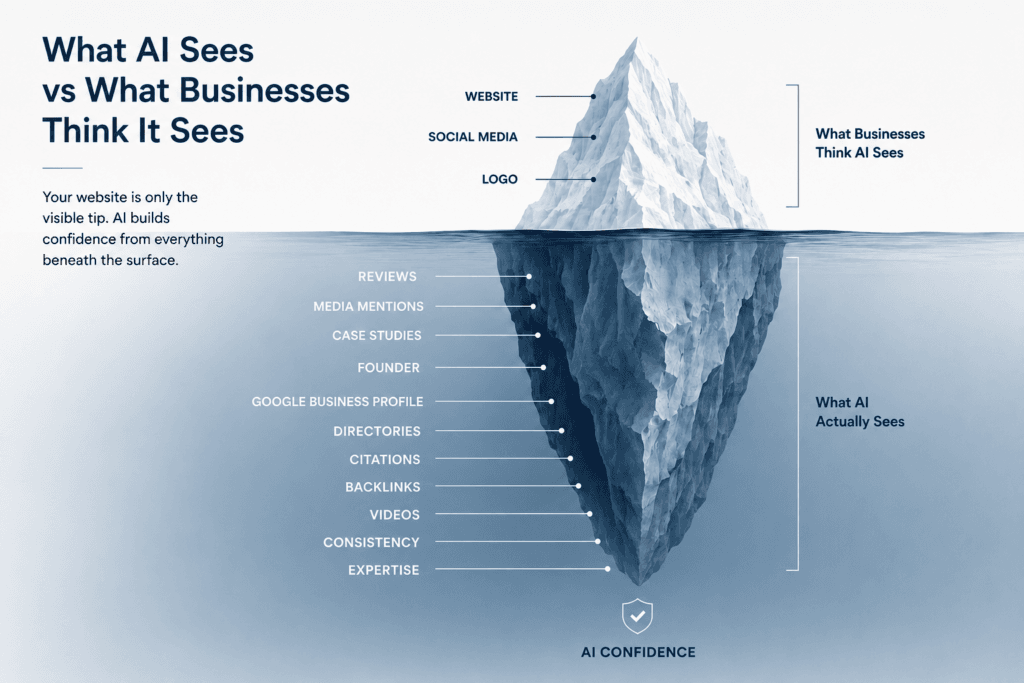
And this is where most of the businesses are falling short.
Why AI Isn’t Recommending Most Businesses
1. Weak Topical Authority
Businesses often create content to promote themselves. AI looks for businesses that consistently educate. If you’re a real estate developer, publishing only project updates tells AI what you sell. Publishing around RERA, home loans, investment decisions, construction quality and buyer concerns tells AI what you know. That’s how topical authority is built.
2. Weak Digital Footprint
Your website is only one piece of the puzzle. AI builds its understanding by connecting signals from your Google Business Profile, LinkedIn, reviews, business directories, news articles, YouTube Videos, Reddit and other trusted sources. The stronger and broader your digital presence, the easier your business becomes to verify—and recommend.
3. Inconsistent Information
AI cross-checks information before it recommends anyone. Different business descriptions, outdated listings, inconsistent services or missing business details create uncertainty. Even Schema Markup—the structured data that helps search engines understand your business—plays a role in reducing ambiguity. The clearer and more consistent your digital presence, the greater AI’s confidence.
4. No Third-Party Credibility
Your website tells AI who you are. Independent sources tell AI whether it should believe you. Reviews, media coverage, reputable backlinks, industry mentions, awards and customer case studies act as external proof. GEO research increasingly points to these earned signals as one of the strongest influences on AI recommendations.
5. Generic Content
AI has already read thousands of articles titled “5 Benefits of Digital Marketing.” Repeating what’s already available doesn’t build authority. Publishing original insights, real case studies, founder perspectives and first-hand experience does. That’s also the direction of Google’s Helpful Content system—it rewards content that contributes something genuinely useful.
6. Thin Service Coverage
Most websites explain everything through a single generic Services page. That’s rarely enough for AI. Detailed service pages, FAQs, case studies and topic-specific content provide the context AI needs to answer user questions accurately. This is where Answer Engine Optimisation (AEO) differs from traditional SEO. It’s not just about ranking pages—it’s about helping AI answer questions with confidence.
7. Weak Entity Signals
AI doesn’t see pages; it sees entities. It connects your website, founders, reviews, social profiles, citations and media mentions into one digital identity. The stronger those connections, the easier it becomes for AI to recognise, understand and recommend your business.
Recommendation Is the New RanKING
For over two decades, businesses competed to rank higher on search engines. The next decade will be different.
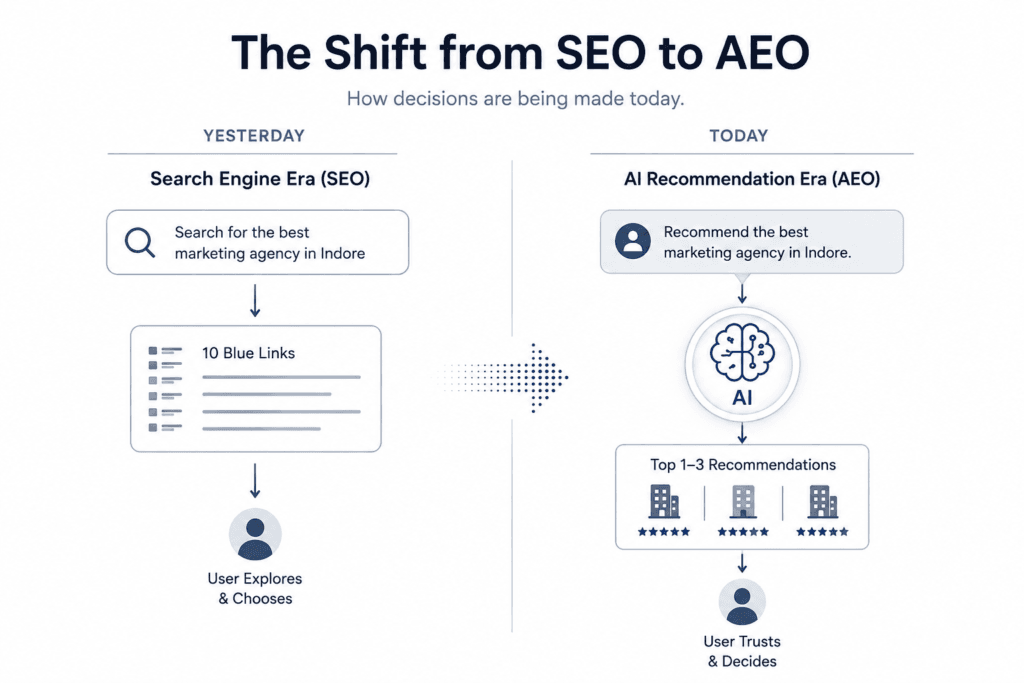
According to Gartner, organic search traffic could decline by 50% or more by 2028 as AI-generated answers become the primary way people discover information. SEO isn’t disappearing—it’s evolving into Generative Engine Optimisation (GEO) and Answer Engine Optimisation (AEO).
As AI becomes the first place people turn for answers, they aren’t just searching—they’re asking who to hire, where to study, which agency to work with, what product to buy, and which brand to trust. In that world, businesses won’t compete for visibility alone—they’ll compete to become the recommendation.
Because in the age of AI, recommendation is the new ranKing. If your business isn’t appearing in AI recommendations today, it’s worth understanding why. Spartan would be happy to help you with that.
FAQs
1. Why isn’t ChatGPT recommending my business?
AI doesn’t recommend businesses based on rankings alone. It looks for consistent, credible evidence across your website, reviews, media mentions, business listings, and other trusted sources.
2. Does ranking #1 on Google mean AI will recommend my business?
Not necessarily. While rankings help with visibility, AI also considers expertise, third-party credibility, topical authority, and consistency before making recommendations.
3. What is Generative Engine Optimisation (GEO)?
GEO is the practice of improving your digital presence so AI platforms like ChatGPT, Gemini, and Perplexity can better understand and recommend your business.
4. How can I improve my chances of being recommended by AI?
Focus on building topical authority, publishing original content, maintaining consistent business information, earning credible mentions, and strengthening your overall digital footprint.
5. Can small businesses get recommended by AI?
Yes. AI doesn’t automatically favour larger brands. Businesses with clearer expertise, stronger credibility, and better digital evidence can often outperform much larger competitors.