

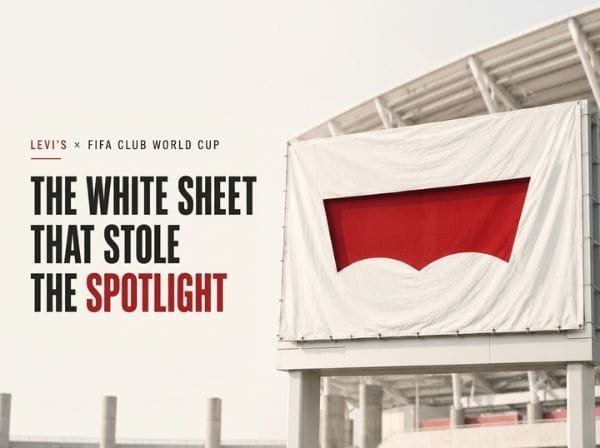
The biggest marketing story of this FIFA Club World Cup wasn’t a goal, a trophy or a player. It was a logo nobody was supposed to see.

The Trending Marketing Story of the Tournament
When the final whistle blows at MetLife Stadium in New Jersey, football will celebrate its newest world champions. The marketing industry, however, may continue discussing something that happened far from the pitch—a giant white cover concealing the Levi’s Batwing outside Levi’s Stadium.
Like every major sporting event, FIFA enforces a strict Clean Venue Policy, requiring non-sponsor branding inside official venues to be concealed. That’s how the Batwing outside Levi’s Stadium ended up hidden beneath a giant white cover.
Over the past few weeks, that image has dominated LinkedIn feeds, agency newsletters, podcasts and marketing publications. Most analyses have reached the same conclusion: Levi’s turned FIFA’s restrictions into a masterclass in ambush marketing. According to media intelligence firm UNICEPTA, the campaign generated an estimated 158 million in earned media reach, reportedly outperforming several official FIFA sponsors like Coca Cola, McDonalds, and others, while industry estimates suggest it crossed 500 million organic impressions.
The campaign has rightly been celebrated for its creativity. But I think we’ve become more interested in how Levi’s capitalised on the moment than why the moment became so powerful in the first place.
Would the same white tarp have sparked the same conversation if it had covered the sign of a lesser-known fashion brand? Or even a globally recognised brand whose identity depends largely on its wordmark, like Zara? It’s difficult to imagine that happening in this particular case.
That’s where this stops being just an ambush marketing story.
The White Cover Wasn’t the Real Story
There’s a concept marketing scientist Byron Sharp often writes about called distinctive brand assets—the colours, shapes and symbols that make a brand recognisable even when its name disappears. The Batwing, Nike’s Swoosh, McDonald’s Golden Arches and Heinz’s bottle all work this way. They don’t just identify a brand; they become mental shortcuts to it.
The Levi’s Batwing is one of those rare assets.
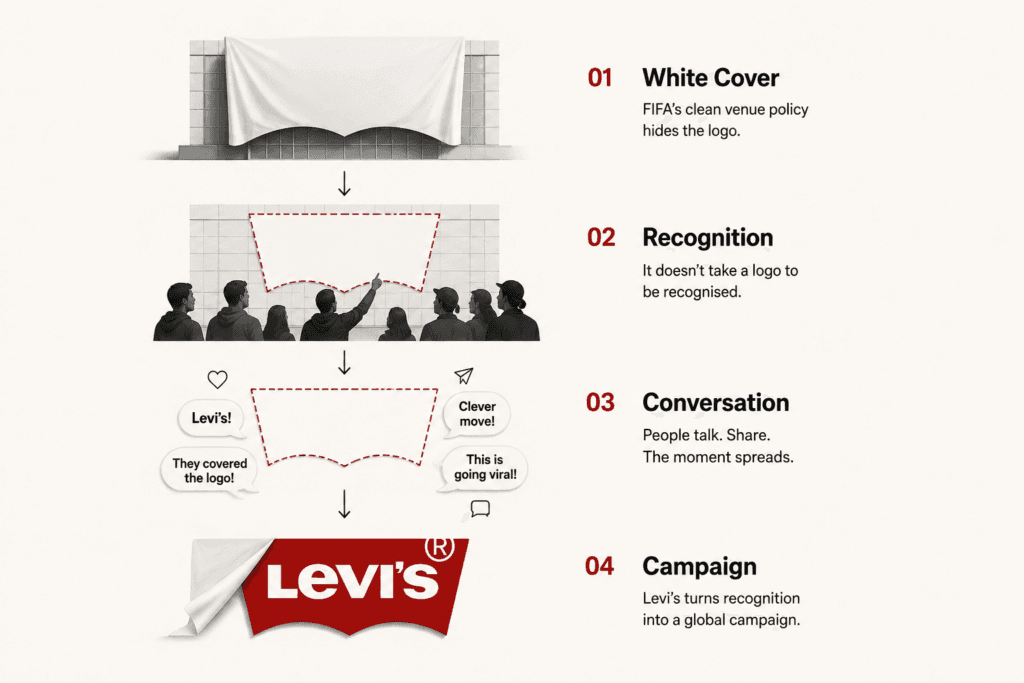
Think of the white sheet as the flash of a camera. A flash never creates the photograph; it simply reveals what already exists. FIFA’s Clean Venue Policy removed the logo, the typography and the colour, yet millions still recognised what lay beneath it. In many ways, the tournament unintentionally became a real-world test of brand memory.
Levi’s wasn’t alone. FIFA’s Clean Venue Policy also forced Heinz to tape over its ketchup bottles inside official venues because it wasn’t a tournament sponsor. Rather than resisting the restriction, Heinz embraced it through its “Unofficial Stadium Ketchup” campaign. Gillette responded in a similar spirit, reimagining its covered stadium branding with shaving foam. Different executions, same principle: when a brand has invested in distinctive assets, even concealment can become communication.
Levi’s Turned Curiosity Into a Campaign
By the time Levi’s responded, the internet had already done the difficult part. People had noticed the white cover. More importantly, they already knew what was hiding beneath it.
Many brands would have acknowledged the moment with a clever social post and moved on. Levi’s did something more disciplined.
The concealed Batwing became its Instagram profile picture. Short-form videos leaned into the viral “Nobody’s Gonna Know” trend. Trucks carrying “Nothing To See Here” circled the stadium. Limited-edition merchandise adopted the same visual language, while flagship stores from London to Hong Kong recreated the covered façade.
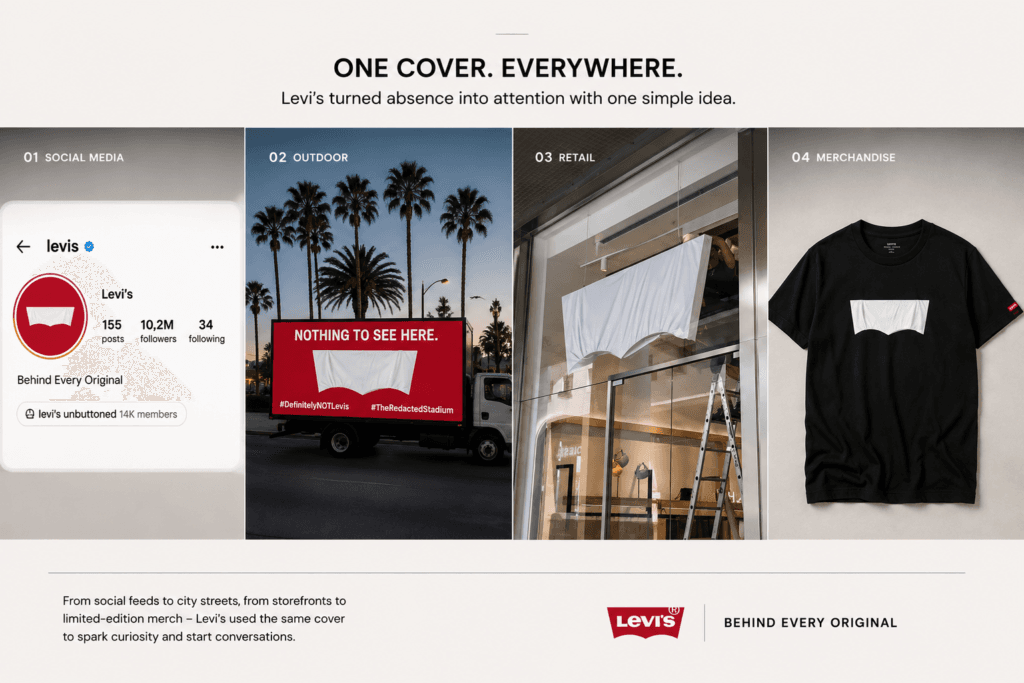
None of these executions tried to become the next big idea. They all pointed back to the first one. Whether someone encountered the campaign on Instagram, through a news story or inside a flagship store, every touchpoint reinforced the same image instead of competing with it. That’s how a viral photograph became a global campaign.
What Brands Can Learn From Levi’s
1. Build distinctive assets before you need them
A viral moment can attract attention, but only strong brand assets make that attention instantly meaningful. The Batwing wasn’t recognised because of the white cover; the white cover worked because people already knew the Batwing.
2. Don’t just capture attention. Build on it
Many brands react to cultural moments with a single post. Levi’s recognised that attention has a short shelf life and extended one visual idea across retail, outdoor, merchandise and social media, turning a moment into a campaign.
3. Treat consistency as a growth strategy
The campaign wasn’t built on dozens of ideas. It was built on one idea repeated consistently across every customer touchpoint. That’s what made it memorable, and it’s a reminder that great marketing often comes from reinforcing the right asset rather than constantly inventing a new one.
Perhaps that’s the biggest takeaway from this FIFA Club World Cup. The white cover sparked the conversation. The Batwing sustained it. And Levi’s made sure the world kept talking.
References
This analysis draws on official brand communications and industry reporting, including:
- FIFA World Cup 2026 – Stadium Code of Conduct (Official PDF)
https://digitalhub.fifa.com/m/50ebae81c412b7d5/original/FIFA-World-Cup-2026-Stadium-Code-of-Conduct.pdf - UNICEPTA (Media Intelligence)
https://www.unicepta.com/ - Levi’s Official Instagram
https://www.instagram.com/levis/ - Exchange4Media — How FIFA’s Branding Rules Created an Unexpected Marketing Moment
- The Wall Street Journal — FIFA Told Stadium Sponsors to Get Lost. They Spun It Into Marketing Gold.
- Forbes — FIFA Covered Levi’s And Heinz. Curiosity Did The Rest.
- MediaPost — Levi’s, Gillette Gently Mock World Cup Branding Ban
Enjoyed this analysis?
At Spartan Media, we believe great marketing deserves to be studied, not just celebrated. Through our articles, we break down campaigns, branding strategies and consumer psychology to uncover the thinking behind them. The same strategic approach shapes the brands, campaigns and digital experiences we create for our clients.